Agriculture and Peatlands 2024 Road Trip
Prepared by Dr Catherine O’Connell, Chair, Irish Peatland Society
The Peatland Road Trip 2024 organised by the Irish Peatland Society was based on the
theme of agriculture. Forty members participated on a two day programme. They visited
five peatland sites where innovative work and research is being undertaken to develop
farming techniques that help contribute to protecting soil carbon, reducing greenhouse gas
emissions and enhancing wetland habitat quality. The sites visited were located in
Counties Offaly and Tipperary in the midlands of Ireland.
The focus on peatlands and agriculture was chosen because of an ambition of the
Common Agricultural Policy to create coherence between agricultural and climate policies.
Carbon sinks such as peat soils are a target for action in reaching climate neutrality by
2050. It is estimated that up to 335,000ha of organic peat soils are being farmed in Ireland
with emissions in the region of 8-9 million tonnes CO2 equivalent annually. The use of
peatlands in farming requires drainage. The negative consequences are release of stored
carbon, reduction in water quality and land subsidence. The peatland roadtrip sought to
learn how greenhouse gas emissions are being measured from agicultural peatlands and
what wise use management strategies are currently being developed to achieve low-
emission goals with benefits to farmers, the economy, society and the environment.
At two sites visited - Doorey and Gurteen Agricultural College - participants were shown
eddy covariance flux towers which have been set up to measure greenhouse gas budgets
at the ecosystem level. These are part of NASCO - the National Agricultural Soil Carbon
Observatory - being run by Teagasc, the farm advisory board. Each year 17,500 data
measurements are recorded from the towers. At one of the peat soil sites at Gurteen
Agricultural College a ReWET project is also underway whereby scientific data is being
recorded on greenhouse gas emissions following manipulation of the water table in the
farmed peat soil through drain blocking. The preliminary results from the towers which are
part of a network of 28 across the country are expected in 2026. They will help to inform
agricultural policy. This policy will be put into action on the ground through the distribution
of results-based payments to farmers via ACRES (Agri-Climate Rural Environment
Scheme). ACRES was developed as part of Ireland’s CAP Strategic Plan. At present
50,000 out of 135,000 farms in Ireland have signed up to ACRES.
At Erry we heard about the FarmPeat project. This project is coming to completion in 2024
and has successfully engaged 53 farmers in a series of actions that “slow the flow” of
water draining across their lands from peatlands of conservation importance. Drain
blocking is a desirable outcome of this project which has the benefit of reducing
greenhouse gas emissions from the re-wetted peat and in time will help to improve farm
biodiversity with minimal impact on farm viability. This is a results based initiative whereby
a farm is scored at the outset and any works undertaken to improve biodiversity and water
retention are rewarded financially.
At Gortavalley Farm we were introduced to FarmCarbon, an EIP project and a sister
project of FarmPeat. At this farm we saw experimental plots growing a wide range of
produce of potential value to the farmer, some of which may have a high commercial
value. The trials are an example of paludiculture and included blueberries, Typha reeds
and floating reed dominated wet grassland suitable for grazing livestock.
The fifth site visited was Ballaghurt Bog, a former industrial peat production bog run by
Bord na Móna. Participants were shown drain blocking and re-profiling works beingundertaken to raise the water table on the site which is facilitating natural colonisation by vegetation. This work is being funded through the Peatlands Climate Action Scheme
(PCAS), also referred to as the Enhanced Decommissioning, Rehabilitation and
Restoration Scheme (EDRRS). We were shown a Sphagnum growing project where up to
one million Sphagnum plugs have been planted as an example of paludiculture. This work
is being undertaken as part of Peatlands and People, an EU- Life funded project.
Thank You
The Irish Peatland Society are grateful to the sponsors of the Peatland Road Trip 2024 -
Bord na Móna, National Parks and Wildlife Service (through the Tóchar Wetlands
Restoration Scheme and National Monuments) and RPS.
We also acknowledge the presenters we met at each site and thank them for their lively
and informative presentations and hospitality.

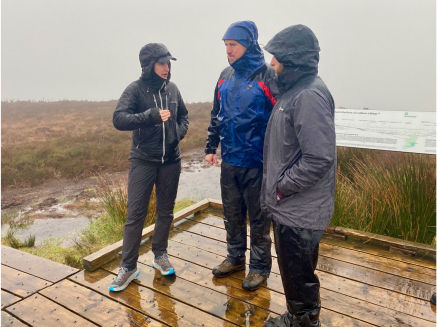
Image: members of the Irish Peatland Society being shown the eddy covariance flux tower at Doorey in Co. Offaly. This is one of a series of 28 towers located on a variety of farm soil types across Ireland including mineral soils and peat soils. They continuously measure carbon dioxide and other greenhouse gases at 10Hz. The towers are managed by Teagasc, the Irish Farm Advisory Board and the first results are expected in 2026. These will be used to influence agricultural policy in Ireland, bringing it into line with climate policy and the shared goal of climate neutrality by 2050. Photo: © C. O’Connell


Comments